How Dow Built a Carbon Footprint Ledger on Databricks to Accelerate Sustainability at Scale
by Jesse Grekowicz, Tim Licquia and Varun Mahajan
- Dow built a Carbon Footprint Ledger (CFL) on the Databricks Data Intelligence Platform to unify enterprise data and calculate cradle-to-gate Product Carbon Footprints (PCFs) for its entire portfolio.
- Apache Spark, Delta Lake, Unity Catalog, and MLflow collapsed end-to-end PCF processing time from weeks to a fraction of that, with full lineage and audit-grade governance.
- The CFL is designed to be third-party assured against ISO 14067 and the GHG Protocol Product Standard, and powers Dow's Decarbia™ low-carbon product portfolio, helping customers verifiably reduce Scope 3 emissions.

Why we built the Carbon Footprint Ledger
At Dow, our ambition is to be the most innovative, customer-centric, inclusive, and sustainable materials science company in the world. Central to that is our Decarbonize & Grow strategy, investing in both growing our ability to serve customers while reducing greenhouse gas emissions.
Across industries, many of our customers are committed to reducing their Scope 3 emissions, the indirect greenhouse gas emissions occurring across a company's value chain, including purchased goods, transportation, and the use of sold products. Regulatory frameworks like the EU's Corporate Sustainability Reporting Directive (CSRD) are raising the bar on environmental disclosure. We recognized and addressed a critical need: a transparent, verifiable system to track and communicate the carbon footprint of every product we manufacture.
The result is the Carbon Footprint Ledger (CFL), a digital tool based on carbon accounting methodology that is third-party limited assured against ISO14067 and the GHG Protocol Product Standard. The CFL is Dow’s #1 ranked digital capability in our Advance Sustainability Program, spanning businesses and functions across the company.
The CFL Methodology & Tool: Challenge Solved
A Product Carbon Footprint (PCF) represents the total greenhouse gas emissions, measured in CO2 equivalent (CO2e), generated from raw material extraction through manufacturing. The CFL sits on top of these calculations and delivers two powerful capabilities:
Optimization - Dynamically assigning the lowest-carbon inputs to optimize a product's carbon attributes (i.e., CO2e) and support monetization of our decarbonization investments.
Verifiable certification - Issuing Product Carbon Footprint certificates for low-carbon products across our global manufacturing network, with residual balances maintained in a secure, auditable ledger, consistent with established mass-balance conventions in GHG accounting.
In practice, the CFL combines a standards-based carbon-accounting methodology with a calculation engine and a certificate-issuing ledger. The calculation engine computes CO2e values across a product's upstream ingredients in accordance with ISO 14067 and the GHG Protocol Product Standard. The ledger records the Product Carbon Footprint certificates issued to customers and maintains residual balances, providing a transparent, auditable record of the low-carbon products Dow delivers.
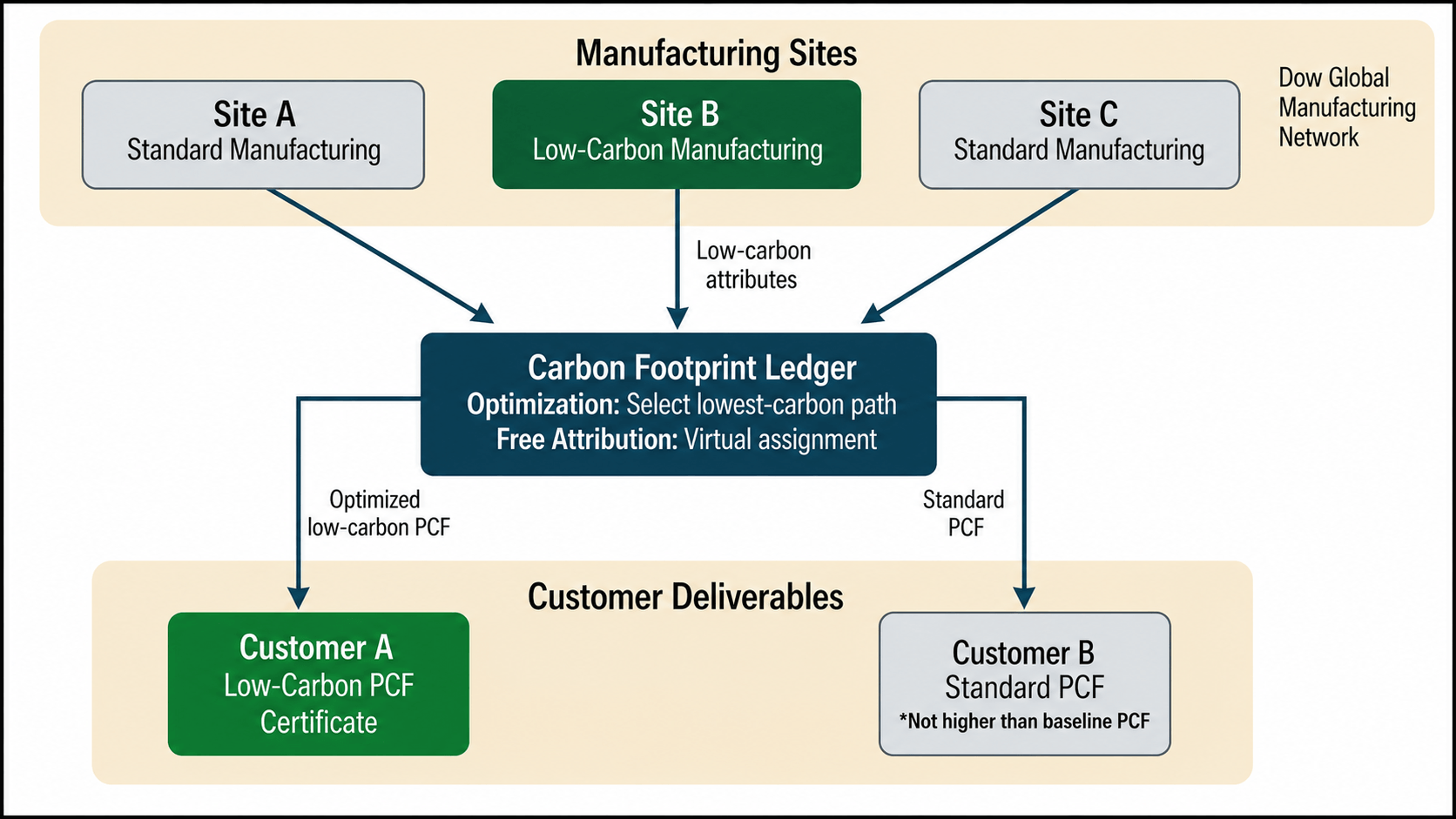
Calculating PCFs for a global materials science company as vast as Dow is inherently complex: each product's carbon footprint requires data from raw material sourcing, manufacturing execution, energy consumption, transportation, emissions monitoring, and lifecycle inventory databases. Previously, this calculation took weeks to complete. The data resided in silos across functions and geographies, and the optimization calculations needed across our manufacturing network were computationally intensive. We needed a platform that could unify data at scale, run complex optimization models in production, and deliver results at the speed of business.
Building the CFL on the Databricks Data Intelligence Platform
Our Enterprise Data & AI (ED&AI) team chose the Databricks Data Intelligence Platform as the foundation for the CFL. We built an end-to-end pipeline within our Integrated Data Hub (IDH), ingesting, transforming, and unifying data from across the organization into a single, automated system. Unity Catalog provides the governance layer, ensuring that sensitive manufacturing data, proprietary emissions factors, and customer-specific carbon allocations are secured with fine-grained access controls throughout the pipeline.
Dow Data integration with Apache Spark
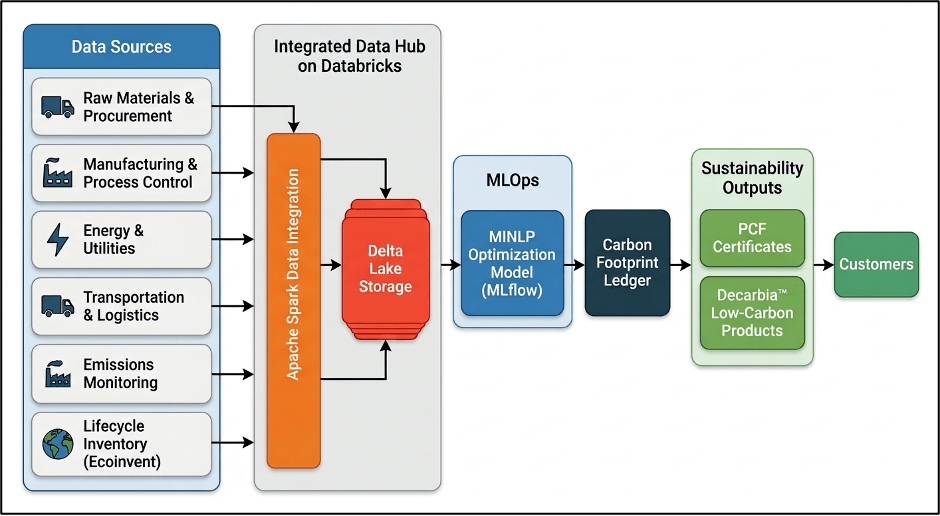
At the heart of the CFL platform is Apache Spark on Databricks, providing the distributed processing power needed to join and transform data from many different functional domains at scale. The CFL pipeline integrates supply-chain, sustainability, and operations data into a unified view, reconciling them into accurate, auditable cradle-to-gate product carbon footprints. Each stage of the pipeline is persisted as Delta tables, giving us ACID transactions, time travel for historical audits, and efficient upserts.
By leveraging Spark's distributed computing capabilities, we collapsed our end-to-end processing time from weeks to a fraction of that, enabling rapid generation of PCF information for all Dow products in a single run.
MLOps for advanced optimization
A central capability of the CFL is an advanced optimization model that dynamically identifies the lowest-greenhouse-gas production pathway for products across Dow's global manufacturing network, consistent with the methodology assured against ISO 14067 and the GHG Protocol Product Standard.
Using Databricks' MLOps approach with MLflow, our team develops and deploys this optimization capability as a production-grade service with full versioning and monitoring. The resulting carbon footprint data flows into the CFL pipeline with full lineage tracking, and updates to underlying data or parameters flow seamlessly into production.
A vision for sustainability intelligence
The CFL is part of our broader Advance Sustainability Program, which encompasses over 20 digital capability tracks, from automated lifecycle assessments to circular materials management to EU Taxonomy compliance. The Integrated Data Hub on Databricks serves as the connective tissue, enabling a future where Dow scientists generate a product carbon footprint with the push of a button, commercial teams match sustainability content to customer needs, and external stakeholders receive sustainability reporting with the same timing and audit assurance as financial reporting.
We’re not there yet on every front, but the CFL on Databricks has been a foundational step toward this vision.
Business impact and looking ahead
The CFL on Databricks delivers tangible results:
- Speed: PCF calculations that once took weeks now complete rapidly, enabling agile response to customer requests
- Scale: Carbon footprint data for our entire product portfolio, not just a handful of flagship products
- Optimization: Products receive the lowest achievable carbon footprint by identifying the best ingredients and production pathways across Dow's manufacturing network, consistent with the assured methodology.
- Monetization: Commercial value from decarbonization investments through Dow's Decarbia™ low-carbon product portfolio
The CFL issues verifiable Product Carbon Footprint certificates and maintains residual balances in a secure, auditable ledger, helping customers make informed sourcing decisions and demonstrate progress against their sustainability targets.
As sustainability regulations tighten globally, our investment in the CFL positions Dow as a leader in product-level carbon transparency. The Databricks Data Intelligence Platform gives us the flexibility and scale to grow with whatever comes next. For us at Dow, the Carbon Footprint Ledger is more than a data project. It's a demonstration of how modern data engineering and digital innovation can drive real-world environmental impact at global industrial scale.
Learn how Databricks accelerates sustainability outcomes for manufacturers and energy companies on the Databricks Manufacturing & Energy solutions page. To explore how the Data Intelligence Platform can power your own sustainability initiatives — from emissions accounting and Scope 3 reporting to circular materials management — contact your Databricks account team or visit databricks.com/solutions/industries/manufacturing-industry-solutions.
Get the latest posts in your inbox
Subscribe to our blog and get the latest posts delivered to your inbox.